Shopware 5 to 6 Migration for a Large Multi-Channel Commerce Setup
Recordcase needed to migrate a live Shopware 5 environment with high order volume, a large customer base, multiple sales channels, multiple language stores, and a broad plugin footprint. BrandCrock supported the migration with a phased Shopware 6 approach built around staged environments, repeated synchronization, plugin review, preservation of business-critical custom functions, and controlled go-live execution.

Project Snapshot
Client:
Recordcase
Platform:
Shopware 5 → Shopware 6
Industry:
Music Equipment & DJ Gear eCommerce
Business Model:
B2C & B2B
Scope:
Migration, staged rollout, backend redevelopment, design adaptation, plugin review, custom function redevelopment, go-live, email template redesign, version updates, long-term support
Delivery Pattern:
Multi-channel, multi-language, large historical dataset, live migration constraints, custom plugin-heavy setup
The Challenge
Recordcase was not dealing with a simple platform upgrade. The migration had to be executed while the live Shopware 5 shop continued operating, with new orders, customers, and catalog changes entering the source system throughout the project.
At the same time, the existing setup depended on a broad plugin landscape and several business-specific functions that could not simply be copied into Shopware 6 without review. The new Shopware 6 store also had to preserve the familiar visual structure and navigation logic that customers already knew, while moving to a more maintainable setup.
Key challenges
- High-volume migration from Shopware 5 to Shopware 6
- 7 sales channels and 6 language stores in one setup
- Live shop operations could not be paused during migration
- New data continued to enter the source system during transition
- Plugin-heavy legacy setup requiring review and adaptation
- Shopware-5-specific fixes were not suitable for direct transfer
- Business-specific logic had to remain available after migration
- Familiar design and navigation needed to be preserved as closely as possible in Shopware 6
- Customer communication also had to be updated to match the new Shopware 6 environment
What We Delivered
BrandCrock handled the project as a phased Shopware migration and redevelopment stream rather than a one-time transfer.
A staged environment model made it possible to prepare and validate the Shopware 6 target setup while the live Shopware 5 shop remained operational. This reduced migration risk and allowed repeated testing, plugin review, and synchronization work without disrupting daily business.
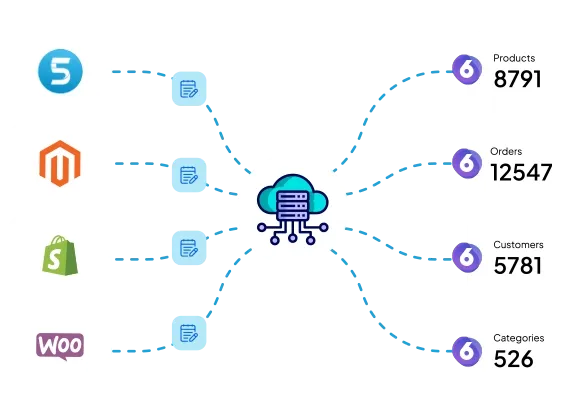
The migration itself was structured in multiple phases. Core datasets such as orders, customers, products, categories, media, and reviews were migrated first. Later synchronization cycles reduced the gap between the live Shopware 5 source system and the Shopware 6 target environment before final transition.
In parallel, BrandCrock reviewed the plugin landscape and the client’s custom functions instead of carrying everything over without control. Where legacy fixes were no longer suitable, they were removed. Where functionality remained business-critical, it was rebuilt or adapted for the Shopware 6 setup.
The project also included backend redevelopment, design adaptation for custom functions, SEO URL continuity through a dedicated plugin approach, and feature work to support warranties, alternative products, PDF documents, free-article logic, and dealer registration requirements. In addition, the order confirmation email template was redesigned so that customers received more structured and professional communication in a format closer to the previous Shopware 5 pattern across all language shops. After migration, BrandCrock continued to support the platform through ongoing operational work and version updates.
Implementation Highlights
01
Migration architecture for live operations
The business needed to continue trading while migration work progressed. BrandCrock used a staged setup built around live Shopware 5, staging Shopware 5, and staging Shopware 6 so migration and validation could be handled without disrupting the active store.
Outcome: migration work could progress in a controlled way while daily operations continued.
02
Multi-phase migration and repeated synchronization
Because new data continued to enter the live system, a one-time migration would have become outdated quickly. BrandCrock used repeated migration runs and later synchronization to reduce the gap between source and target data.
Outcome: the Shopware 6 environment stayed more closely aligned with the live business before final cutover.
03
Plugin review and custom-function preservation
The Shopware 6 target setup was not treated as a direct copy of the old shop. Plugins were reviewed, reduced, replaced, or rebuilt where needed, and important custom functions were preserved in the new environment.
Outcome: the migration avoided carrying unnecessary legacy complexity forward while retaining business-critical capabilities.
04
SEO URL continuity through custom mapping
The client required product and category URLs to remain aligned with the old Shopware 5 structure. BrandCrock developed a custom plugin to map these URLs into the Shopware 6 product and category data.
Outcome: URL continuity was preserved more effectively during migration, helping reduce SEO disruption.
05
Custom plugin redevelopment for operational workflows
BrandCrock developed and adapted multiple custom functions, including warranty handling, alternative-product suggestions for out-of-stock items, unlimited PDF tabs on product pages, free-article logic, and dealer registration functionality.
Outcome: important commercial and operational workflows remained available in the Shopware 6 setup instead of being lost during migration.
06
Email template redesign for all language shops
The client requested a redesign of the order confirmation email template so that customer communication would appear more structured and professional, closer to the Shopware 5 pattern they were used to. BrandCrock redesigned the template across all language shops.
Outcome: transactional communication became more consistent with the broader migration and storefront transition.
07
Ongoing Shopware version updates and maintenance
After go-live, the client assigned BrandCrock ongoing support and maintenance. Whenever a new Shopware version was released, BrandCrock first informed the client, executed the update process in staging, tested the result, and then deployed it to the live site.
Outcome: the platform remained up to date for security and feature improvements, while updates were handled in a controlled way without unnecessary disruption.
08
Go-live with minimal downtime
The final Shopware 6 shop was taken live with only 2 hours of downtime.
Outcome: the transition to the new platform was completed with minimal interruption to business operations.
09
Redis integration for performance optimization
BrandCrock integrated Redis caching into the Shopware environment to improve performance, reduce server load, and optimize response times for storefront operations.
Outcome: the platform achieved faster loading times and more stable performance, especially during higher traffic and operational load.
Outcome
The project delivered a migration path that matched the real scale and complexity of the Recordcase setup.
BrandCrock did not only move data. The project preserved business continuity, adapted custom functionality for Shopware 6, supported the familiar user experience where possible, improved customer-facing email communication, and created a more maintainable target platform for long-term operations.
- 142,000+ orders migrated into Shopware 6
- 231,000+ customers transferred as part of the migration
- 10,000+ products included in scope
- 7 sales channels and 6 language stores covered
- Migration of products, orders, customers, media, categories, and reviews
- Plugin dependencies reviewed instead of transferred blindly
- SEO URL continuity supported through custom plugin logic
- Business-critical custom functions preserved in the new setup
- Repeated synchronization used to reduce live-data drift
- Shopware 6 go-live completed with only 2 hours downtime
- Order confirmation email templates redesigned for all language shops
- Ongoing Shopware version updates handled through staging, testing, and controlled live deployment
- Long-term operational support continued after migration
Planning a complex Shopware migration?
If your shop includes large data volumes, custom plugins, SEO-sensitive URLs, or live operational constraints, a one-pass migration is rarely enough. A structured technical migration review can reduce avoidable risk before data drift, plugin dependencies, and transition issues slow the project down.