
Avoria Liquids
Avoria’s Successful B2B Transformation
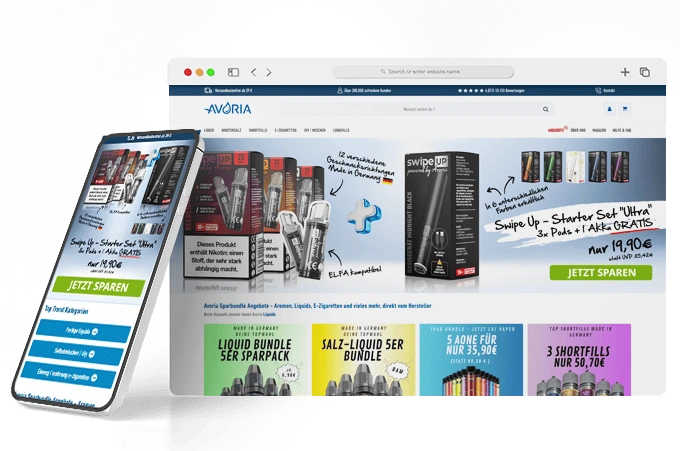
How Recordcase prepared a live, plugin-heavy Shopware environment for a controlled transition to Shopware 6 without disrupting daily operations
Avoria stands as a trusted provider of top-tier vaping products and e-liquids, catering to both businesses and individual customers. Focused on delivering quality and consistency, the company develops products that meet exacting standards. Its products are tailored to address the unique demands of B2B partners, ensuring functionality and reliability, while also offering a seamless experience for individual consumers.
Avoria Liquids
Platform:
Shopware 5 → Shopware 6
Business model:
E-Commerce / B2C
Scope:
Migration, plugin review, redevelopment of custom functions
Complexity:
Multi-channel, multi-language, large historical dataset, live migration constraints
Key Facts

142K+
Orders Migrated

231K+
Customers Transferred

10K+
Products
included in scope

7 / 6
Sales Channels /
Language Stores Covered

The challenge
This was not a straightforward platform upgrade.
Recordcase needed to migrate from Shopware 5 to Shopware 6 while the live store remained fully operational. New orders, customer records, and catalog changes continued to enter the source system throughout the project. A one-time migration would have become outdated almost immediately.
At the same time, the existing setup relied on 27 third-party plugins as well as multiple custom plugins and legacy adjustments. Not all of them were suitable for direct transfer into Shopware 6. Some needed to be retired, some replaced, and some rebuilt to preserve business-critical logic in a more stable target architecture.
The real complexity came from the combination of factors:
- large volumes of active and historical commerce data
- uninterrupted live operations during the migration phase
- continuous data drift between source and target environments
- a large plugin footprint with functional dependencies
- legacy fixes that were no longer appropriate in Shopware 6
Like the strongest premium case studies in the market, this project was less about “replatforming” in the abstract and more about building a reliable foundation for ongoing commerce operations under real-world constraints. That same framing is visible in the reference cases, where complexity is anchored in business processes, system dependencies, and future scalability rather than in generic relaunch language.
The approach
Shopware 5
Staging
Testing
Shopware 6
BrandCrock handled the Recordcase migration as a phased transition architecture, not as a single transfer event.
A staged setup was used to separate live operations from migration and validation work. This made it possible to prepare the Shopware 6 target environment, test migration runs, review plugin dependencies, and validate business-critical functions while the Shopware 5 shop continued trading.
The migration itself was structured in multiple controlled phases.
Core datasets such as customers, orders, products, and categories were transferred first. Later synchronization runs captured newly created live data so that the target environment could be aligned progressively with the latest state of the source system before the final transition. This reduced the operational gap between old and new platforms and lowered cutover risk.
In parallel, the plugin landscape was assessed in a controlled way rather than copied over blindly. Third-party plugins and custom plugins were reviewed for compatibility, relevance, replacement risk, and future maintainability in Shopware 6. Where legacy fixes were no longer suitable, they were removed. Where business-critical functionality still mattered, it was rebuilt for the new setup.
This mirrors the stronger premium case-study pattern seen in the reference material: focus on phased delivery, a scalable target architecture, and clear operational reasoning behind implementation decisions rather than feature dumping. Strix, for example, frames its case around discovery, MVP prioritization, and scalable rollout, while Shopware’s Zorgboodschap case emphasizes process complexity, system integration, and operational fit.
What was implemented
Migration architecture for live operations
Recordcase needed a setup that allowed migration work to progress without interrupting daily business. BrandCrock used a staged environment model built around the live Shopware 5 system, a staging layer for validation, and a prepared Shopware 6 target environment.
This made repeated migration runs and testing possible without exposing the live business to unnecessary risk.
Multi-phase migration and repeated synchronization
Because the source system continued to change throughout the project, migration had to be repeatable.
BrandCrock structured the migration in phases and used later synchronization steps to transfer newly created records into the target setup. This reduced data drift and improved cutover readiness as the project moved toward final transition.
Plugin review and controlled function preservation
The Shopware 6 environment was treated as a new operational platform, not as a direct copy of the old one.
Plugins were reviewed one by one to determine whether they were still required, whether they could be replaced, and whether custom functionality needed redevelopment. This protected critical business functions while reducing the risk of carrying legacy complexity into the new system.
The outcome
The result was a migration path designed for the actual scale and operating reality of the Recordcase setup.
More than 142,000 orders and 231,000 customers were migrated as part of the transition scope. More than 10,000 products were included, across 7 sales channels and 6 language stores. Beyond the numbers, the project established a more controlled way to move from Shopware 5 to Shopware 6 while preserving continuity in a live commerce environment.
The operational value was clear:
- migration risk was reduced through staged environments and repeated synchronization
- live business continuity was preserved during the project
- plugin dependencies were reviewed instead of transferred blindly
- business-critical custom logic remained available in the new setup
- the target platform was prepared on a more maintainable Shopware 6 basis
That positioning is also what makes premium case studies feel more credible. The better examples do not overstate “innovation”. They show how a business with real constraints gained a more stable, scalable operating model.
Our Partners in Success























See Our Work In Motion
Explore our portfolio, and see for yourself how we’ve helped businesses like yours bring their vision to life.