

Marketing attribution has always been messy, but it used to be manageable. You could mostly trust that Google Analytics showed you where customers came from, which campaigns worked, and what to spend more on versus what to cut.
That’s broken now. Not because the tools got worse, but because privacy regulations and consent requirements changed the game in ways most businesses haven’t fully adjusted to.
GDPR and cookie consent laws are necessary and good for users. But they’ve created a tracking environment where the data you’re using to make advertising decisions is incomplete, biased, and often deeply misleading. And if you’re not accounting for that, you’re almost certainly overspending on some channels while underinvesting in others.
Here’s what’s actually happening: a significant portion of your visitors don’t consent to tracking cookies. Maybe 30%, maybe 50%, maybe more depending on your audience and how your consent banner is configured. Those visitors are invisible to Google Analytics. They browse your site, some of them buy, but GA4 has no record they were ever there.
So when you look at your analytics to see which marketing channels are working, you’re not seeing complete data. You’re seeing a biased sample of only the visitors who consented to tracking. And that sample doesn’t represent your actual customer base.
This creates systematic errors in attribution that make some channels look better than they are and others look worse. The result is ad spend decisions based on incomplete information, which means spending money on tactics that don’t work as well as you think while cutting budget from ones that work better than your data suggests.
Let’s talk about what’s actually broken, why it matters financially, and what you can do about it.
The consent gap nobody talks about honestly
When GDPR and similar regulations came into effect, most stores implemented cookie consent banners because they had to. But very few thought carefully about what those banners would do to their data quality.
Different consent banner configurations get wildly different consent rates. An aggressive banner that makes “Accept All” the obvious choice might get 70-80% consent. A more privacy-respecting banner that makes declining as easy as accepting might get 30-40% consent. The design, copy, and default behavior of your banner directly determines how much of your traffic is trackable.
Most stores have no idea what their actual consent rate is. They implemented a banner, it appears for visitors, and they assume everything’s fine. Meanwhile, half their traffic might be completely invisible to analytics.
Check your actual consent rate. Most consent management platforms can tell you what percentage of visitors accept tracking cookies. If you don’t know this number, you’re flying blind. And if it’s below 60%, your analytics data is severely compromised.
Here’s why this matters beyond just missing data: the visitors who decline tracking are systematically different from those who accept. They’re more privacy-conscious, often more technically sophisticated, frequently more skeptical of marketing. Their behavior and purchasing patterns are likely different from the consenting population.
So your analytics isn’t just missing random data—it’s missing a specific subset of your audience. And when you make marketing decisions based on the subset you can see, those decisions may not apply to the subset you can’t see.
Why GA4 makes the problem worse, not better
Google Analytics 4 was supposed to be the privacy-friendly evolution of analytics. It uses machine learning to fill gaps in data, relies less on cookies, and has consent mode to handle situations where tracking is limited.
In theory, this should help. In practice, it’s created new problems while solving old ones.
GA4’s modeling attempts to estimate traffic and conversions you can’t directly measure. This sounds helpful until you realize the model is being trained on the biased sample of consenting users and then extrapolating to the non-consenting population. If those populations behave differently, the extrapolation will be wrong.
Consent mode in GA4 has two settings: basic and advanced. Basic consent mode stops sending data entirely when users decline cookies—most privacy-focused implementations use this. Advanced consent mode sends limited, anonymized data even when users decline, which allows better modeling but may not be compliant depending on how you’ve interpreted GDPR requirements.
Most stores we see are using basic consent mode because their lawyers or privacy consultants recommended it. This means GA4 is operating with massive blind spots and trying to fill them through modeling that may or may not be accurate.
The reports look complete. Numbers are shown for all your traffic. But underneath, a significant portion is estimated rather than measured. And GA4 doesn’t make it obvious which numbers are real and which are modeled.
This creates false confidence. You look at your analytics, see clear data about where traffic comes from and what converts, and make decisions based on it. You don’t realize that 40% of that data is educated guesswork rather than measurement.
The channel attribution bias that kills budget efficiency
Here’s where incomplete tracking starts costing real money: different marketing channels are affected differently by consent rates.
Paid search traffic, especially branded search, tends to have higher consent rates. People searching for your brand name specifically are already somewhat familiar with you and more likely to accept cookies. So in your analytics, paid search looks great—good traffic volume, strong conversion rates, clear ROI.
Social media traffic, particularly from platforms like Facebook and Instagram, often has lower consent rates. Users coming from social are more casual browsers, less committed, more privacy-conscious. Many decline tracking. In your analytics, social traffic looks weak—low volume that you can measure, poor conversion rates, terrible ROI.
Based on this data, the obvious decision is to spend more on paid search and less on social. That might be right. But it might also be completely wrong if the social traffic you can’t measure is actually converting at reasonable rates.
We’ve seen this pattern repeatedly: stores cut social ad spend because analytics shows it performing poorly, only to see overall revenue drop more than expected. The social traffic was working, but most of it was invisible to analytics due to lower consent rates.
The reverse problem happens too. A channel that looks profitable in analytics might actually be borderline or negative ROI when you account for the unmeasured traffic that didn’t convert. You’re spending based on incomplete information and potentially making expensive mistakes.
The remarketing waste you can’t see
Remarketing is supposed to be efficient—you’re targeting people who already visited your site, already showed interest, just need a nudge to convert. In theory, these campaigns should have great ROI.
But remarketing depends entirely on tracking. If someone visits your site and declines cookies, they don’t enter your remarketing pools. You can’t target them later. They’re invisible to your remarketing campaigns.
So who are you actually remarketing to? Only the subset of visitors who consented to tracking. And this subset is probably already more likely to convert because they’re less privacy-conscious and more receptive to marketing in general.
You’re remarketing to the people who least need it and missing the people who most need it. Your remarketing campaigns look successful in analytics because they’re targeting an already-qualified audience, but they’re missing huge segments of your actual traffic.
The cost here isn’t just wasted ad spend on easy converts. It’s also opportunity cost—all the visitors you can’t remarket to because they declined tracking. Some of those would have converted with remarketing. You just have no way to reach them.
And because your analytics only shows the people you successfully remarketed to, you have no visibility into how large this missed opportunity actually is.
The conversion tracking gap that breaks everything
Even more fundamental than attribution problems: many conversions aren’t being tracked at all.
If someone visits your site without consenting to cookies, browses around, and makes a purchase, depending on your implementation, that conversion might not be recorded in GA4. The order exists in your eCommerce platform. Revenue happened. But as far as Google Analytics knows, nothing occurred.
This creates bizarre situations where your actual revenue (from your eCommerce platform) doesn’t match your tracked revenue (from GA4). The gap between these numbers is un-attributed revenue—sales that happened but you don’t know where they came from.
Some stores have 20-30% of revenue that’s completely un-attributed. They know sales happened. They can’t connect those sales to any marketing source. So when they calculate ROI for different channels, they’re only counting the attributable sales and making decisions as if the un-attributable sales don’t exist.
This systematically undervalues every marketing channel because none of them get credit for the conversions that can’t be tracked. The overall picture looks worse than reality—lower conversion rates, weaker channel performance, worse ROI across the board.
If you’re making budget decisions based on tracked conversions only, you’re probably being too pessimistic about what’s actually working. But you have no good way to distribute the un-tracked conversions back to their actual sources.
The iOS and Safari problem that compounds everything
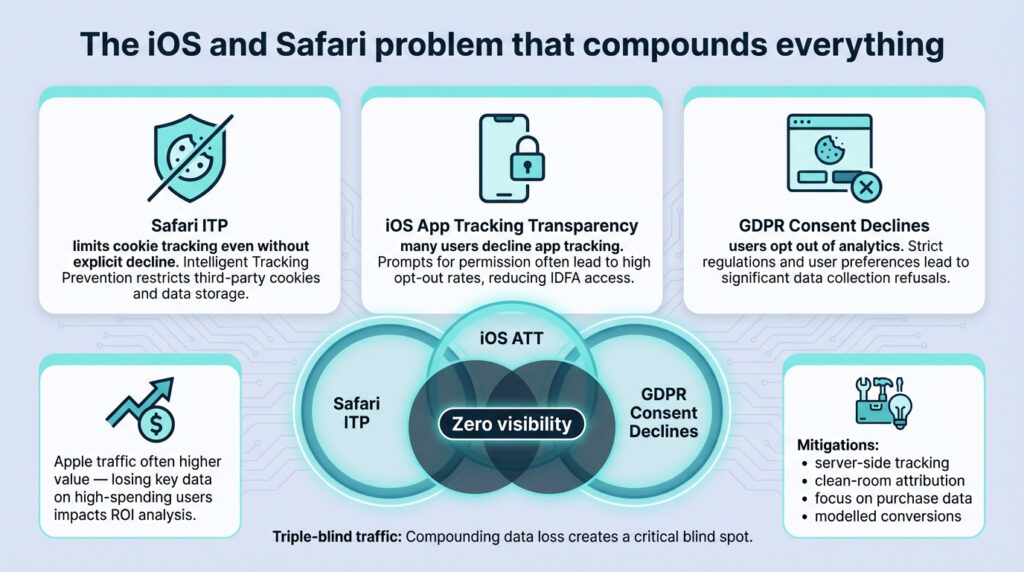
As if consent issues weren’t enough, Apple’s privacy features add another layer of tracking degradation that combines with consent problems to make attribution even worse.
Safari’s Intelligent Tracking Prevention (ITP) severely limits cookie-based tracking even when users haven’t explicitly declined. iOS app tracking transparency requires apps to ask permission for tracking, and most users decline.
This means significant portions of your traffic—particularly from iPhone and Mac users—are difficult or impossible to track accurately regardless of consent. And Apple users tend to be higher-value customers in many markets, which means the traffic you’re missing is often your most valuable traffic.
The combination of GDPR consent requirements and Apple privacy features creates a situation where for some visitors, you have triple-blind tracking: they’re on Safari (tracking limited by ITP), they declined cookie consent (no GA4 tracking), and they’re coming from an iOS app (no app tracking). You have essentially zero information about these visitors unless they complete a purchase and you can see it in your order data.
For stores with high proportions of Apple device traffic, this isn’t a minor issue. It’s the majority of traffic being essentially invisible to analytics. Making ad decisions based on the minority of trackable traffic is not a reliable strategy.
What first-party data actually means and why it matters
The solution everyone talks about is “first-party data”—tracking based on information you collect directly rather than third-party cookies. This works better under privacy regulations and isn’t affected by browser tracking prevention.
But implementing first-party tracking properly is more complex than most stores realize. It’s not just switching a setting in GA4. It requires server-side tracking architecture, proper data handling, and careful attention to privacy requirements.
Server-side tracking sends data from your server to analytics platforms rather than from the browser. This bypasses cookie consent issues (within limits—you still need legal basis for processing) and isn’t affected by browser tracking prevention. It gives you more complete data about visitor behavior.
But it requires technical implementation. You need a server-side tagging setup, proper event tracking, and integration with your analytics platforms. Most stores haven’t done this and are still relying entirely on client-side tracking that’s increasingly unreliable.
Enhanced conversions in Google Ads allow you to send hashed customer data (email, phone) along with conversion events, which helps Google match conversions to ad clicks even when cookies aren’t available. This improves attribution accuracy but requires collecting that customer data and implementing the tracking properly.
Most stores have enhanced conversions configured incorrectly or not at all. They’re leaving attribution accuracy on the table because the setup is technical and nobody’s prioritized doing it right.
The metrics you should be watching instead
If you can’t trust GA4 attribution data completely, what should you rely on for marketing decisions?
Platform revenue vs. tracked revenue. Compare what your eCommerce platform says you earned to what GA4 says you earned. The gap is your un-attributed revenue. If it’s more than 10-15%, your tracking is seriously compromised.
Blended CAC (Customer Acquisition Cost). Take total ad spend across all channels and divide by total new customers (from your platform, not GA4). This gives you average acquisition cost regardless of attribution. It’s less precise but more reliable when attribution is broken.
Incrementality testing. Turn off specific channels completely for periods and measure the impact on overall revenue. This tells you what those channels actually contribute, not what analytics says they contribute. It’s the gold standard for understanding true channel value.
Multi-touch attribution models. Instead of last-click attribution, use models that consider the full customer journey. These are less affected by incomplete tracking because they don’t rely on perfect data about every touchpoint.
Cohort analysis. Track customer lifetime value by acquisition cohort rather than just immediate conversion. Some channels attract customers who buy repeatedly. Others attract one-time buyers. Analytics often misses this difference.
These approaches aren’t perfect, but they’re more robust to tracking degradation than simple last-click attribution from GA4.
The realistic fix that actually helps
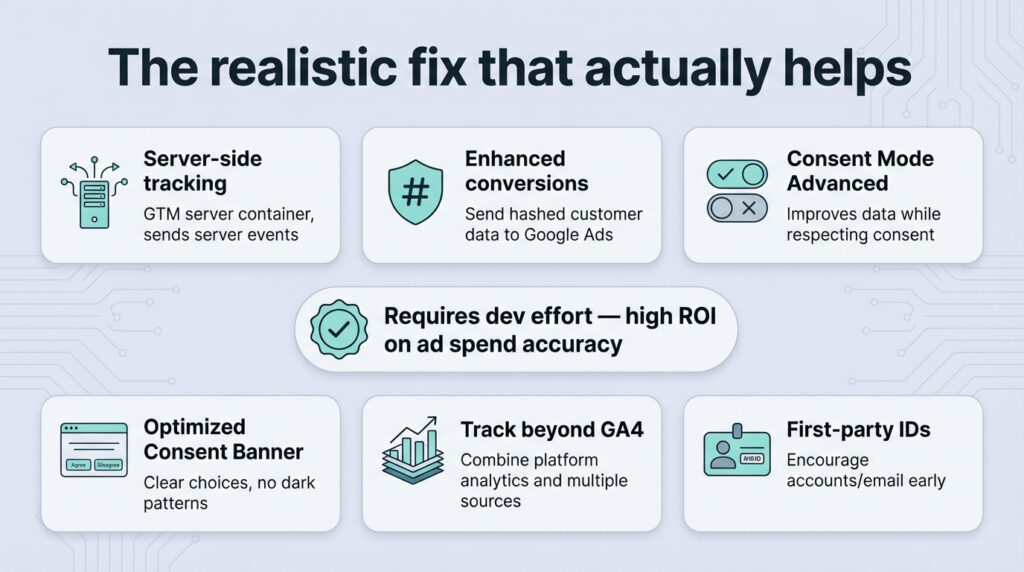
Solving tracking problems completely is impossible under current privacy regulations and browser restrictions. But you can significantly improve data quality with proper implementation.
Implement server-side tracking. Use Google Tag Manager server-side container to send data from your server rather than relying only on browser-based tracking. This captures more complete data while respecting privacy requirements.
Set up enhanced conversions properly. Make sure Google Ads is receiving hashed customer data with conversion events to improve attribution matching.
Use consent mode advanced where legally appropriate. If your legal interpretation allows, advanced consent mode provides better data quality than basic consent mode while still respecting user choices.
Optimize your consent banner for honest choice. Don’t use dark patterns to trick users into consenting, but do make the options clear and the process simple. A well-designed banner can improve consent rates significantly.
Track beyond GA4. Use your eCommerce platform’s native analytics, supplement with other tools, and don’t rely solely on Google’s data. Cross-reference multiple sources to get a more complete picture.
Implement first-party customer identification. Get customers to create accounts or sign up for email early in the journey. This gives you first-party identifiers that work regardless of cookie consent.
None of this is simple. Most of it requires technical expertise to implement correctly. But the improvement in data quality and attribution accuracy is worth the investment if you’re spending serious money on advertising.
What this costs you if you don’t fix it
Let’s put numbers on this. Assume you’re spending €10,000/month on various advertising channels. Your tracking only captures 60% of traffic due to consent and browser restrictions. Your attribution is systematically biased, making some channels look better and others worse than reality.
Conservative estimate: you’re misallocating 20% of your budget based on bad data. That’s €2,000/month or €24,000/year being spent on the wrong things. Maybe you’re overspending on channels that look good in analytics but underdeliver in reality. Maybe you’re underspending on channels that work better than you realize.
Over three years, that’s €72,000 in inefficiency. And that’s just direct waste—it doesn’t count opportunity cost of growth you missed by not identifying which channels actually work best.
For larger advertisers spending €50k or €100k monthly, the numbers scale proportionally. The potential waste from bad attribution is tens or hundreds of thousands annually.
Compare that to the cost of properly implementing server-side tracking and fixing your consent setup—usually €5k-15k in development work plus ongoing maintenance. The ROI is obvious if you’re spending serious money on ads and want those decisions based on accurate data rather than biased samples.
If your tracking is probably broken
Most stores we audit have significant tracking and attribution problems they don’t know about. They’re making ad spend decisions based on incomplete data and wondering why their marketing efficiency keeps declining.
You can check some basics yourself: compare platform revenue to GA4 revenue, check your consent rate, look for large gaps in attribution. If you find problems, at least you know they exist.
But fixing tracking properly requires technical expertise—server-side implementation, proper event tracking, consent mode configuration, enhanced conversions setup. This isn’t work most marketing teams can do themselves. It requires developers who understand both the tracking technology and the privacy requirements.
That’s work we do at BrandCrock. Auditing tracking implementations, identifying where data quality is compromised, implementing proper server-side tracking, and setting up attribution infrastructure that works under current privacy restrictions. Not to achieve perfect tracking—that’s impossible—but to get reliable enough data that ad spend decisions are based on reality rather than biased samples.
If you’re spending significant money on advertising and suspect your attribution isn’t telling the complete story, reach out. We’ll audit your current setup and tell you honestly what’s broken, what it’s probably costing you, and what it would take to fix.
Because the goal isn’t perfect tracking for its own sake. It’s having reliable enough data to make smart decisions about where to spend your marketing budget. Right now, if your tracking is broken, you’re essentially guessing. And guessing with €10k/month is expensive.
Fix the tracking. Stop wasting ad spend on bad data. It’s one of the highest-ROI investments you can make in your marketing infrastructure.


 Alan Bradford
 Aug 10, 2018