

Scaling an eCommerce business has always been presented as a growth problem. Get more traffic. Expand your product line. Enter new markets. Spend more on ads. Hire a bigger team.
But that’s not usually what stops stores from scaling. Most businesses that plateau between €500k and €2M annually aren’t stuck because they can’t get more customers or sell more products. They’re stuck because of decisions they made a year or two ago that now limit what’s possible.
These weren’t obviously bad decisions at the time. They were practical choices that solved immediate problems: choosing a platform that was easy to launch on, hiring the freelancer who was available quickly, building features the fastest way possible, integrating systems with whatever worked, setting up processes that handled current order volume.
Each decision made sense in isolation. But collectively, they’ve created a business that can’t scale without first unwinding a dozen constraints that are now deeply embedded in how the store operates.
We see this constantly. A store hits €750k in annual revenue and wants to double it. They have the market opportunity. They have the capital for marketing. But their platform can’t handle the custom features they need. Their fulfillment process breaks down above 50 orders daily. Their integration architecture is so fragile that adding new tools risks breaking existing ones. Their team doesn’t know how to make changes without causing problems.
The ceiling isn’t market size or product-market fit. It’s operational and technical debt accumulated through hundreds of small decisions that prioritized short-term execution over long-term scalability.
Here’s what’s tricky: you can’t see these constraints clearly when you’re at €200k or €400k revenue. Everything still works. Problems are manageable. The business feels healthy. The constraints only become obvious when you try to grow past them and discover you can’t without significant rework.
But the decisions creating those future constraints are being made right now. And there are specific patterns in how businesses make decisions that predict whether they’ll scale smoothly or hit walls they didn’t see coming.
This decision audit is designed to surface those patterns. Nine questions that reveal whether your current approach to decisions will support growth or create constraints. These aren’t aspirational questions about vision. They’re practical questions about how your business actually operates, how you make choices, and whether those choices compound toward scalability or toward future problems.
If you’re currently under €1M and planning to grow significantly, these questions will tell you where you’re building future constraints you’ll eventually need to fix. If you’re already stuck at a plateau, they’ll probably reveal why.
Question 1: When you add new features, do you know the total cost of ownership?
Most stores evaluate new features based on initial implementation cost. A new payment method costs €5k to integrate. A new shipping provider needs two weeks of dev work. A custom product configurator will take a month to build.
But implementation cost is usually the smallest part of total cost. What about ongoing maintenance? What happens when the payment provider updates their API and you need to modify your integration? What about the monthly fees? The support burden when it breaks? The complexity it adds when you eventually want to migrate platforms or rebuild?
Stores that scale well evaluate features on total cost of ownership over multiple years, not just build cost. They ask: “If we add this now, what does it commit us to maintaining forever? What flexibility do we lose? What future decisions does this constrain?”
Stores that hit scaling walls make decisions based purely on immediate cost and timeline. They accumulate features and integrations and custom code without thinking about the long-term burden of maintaining it all. Eventually, the maintenance load becomes so heavy that they can’t add anything new without first cleaning up the mess of old decisions.
If you’re choosing features based only on “how much to build” and “how long to launch,” you’re probably creating scaling constraints you’ll regret later.
Question 2: Can you explain your technical architecture to someone non-technical?
This sounds like a strange question, but it’s remarkably predictive.
If you can clearly explain how your systems connect—where product data lives, how it flows to your website, how orders sync to fulfillment, how inventory updates, how customer data moves between tools—that means your architecture is probably clean and understandable.
If you can’t explain it without saying “honestly, I’m not really sure how that part works” or “I think the developer set something up but I don’t know the details,” your architecture is probably a mess. And messy architecture doesn’t scale.
This isn’t about you needing to be technical. It’s about whether your systems are simple enough and well-documented enough that someone can understand them. Simple, well-designed systems are explainable. Complex, jury-rigged systems are mysteries that only certain people understand, and sometimes not even them.
Stores that scale have clean, documented architecture where it’s obvious how everything connects. Stores that plateau have mysterious, undocumented systems where adding anything new requires extensive investigation into how existing pieces work and what they might break.
If you can’t draw a simple diagram of your tech stack and explain what each piece does and how they connect, that’s a scaling constraint waiting to happen.
Question 3: When something breaks, do you fix the symptom or the cause?
A page loads slowly. Do you add caching to make it faster, or do you figure out why it’s slow in the first place and fix that?
An integration fails occasionally. Do you build retry logic to work around the failures, or do you figure out why it fails and fix the root cause?
Customers complain about confusing checkout. Do you add more explanatory text, or do you redesign the flow so it doesn’t need explanation?
Stores that scale fix root causes. It takes longer upfront, but it actually solves problems instead of accumulating workarounds. Stores that plateau fix symptoms with patches and workarounds, which is faster initially but creates growing complexity as workarounds pile up.
After a few years of symptom-fixing, you have systems held together with workarounds for workarounds. Everything is fragile. Changes are risky because you don’t know what workarounds you might break. Nobody fully understands how things work because the original logic is buried under layers of patches.
This isn’t about being perfectionist. Sometimes a quick workaround is the right choice. But if workarounds are your default response rather than occasional exceptions, you’re building technical debt that will eventually constrain your ability to grow.
Question 4: Do you have a process for saying no, or does everything seem important?
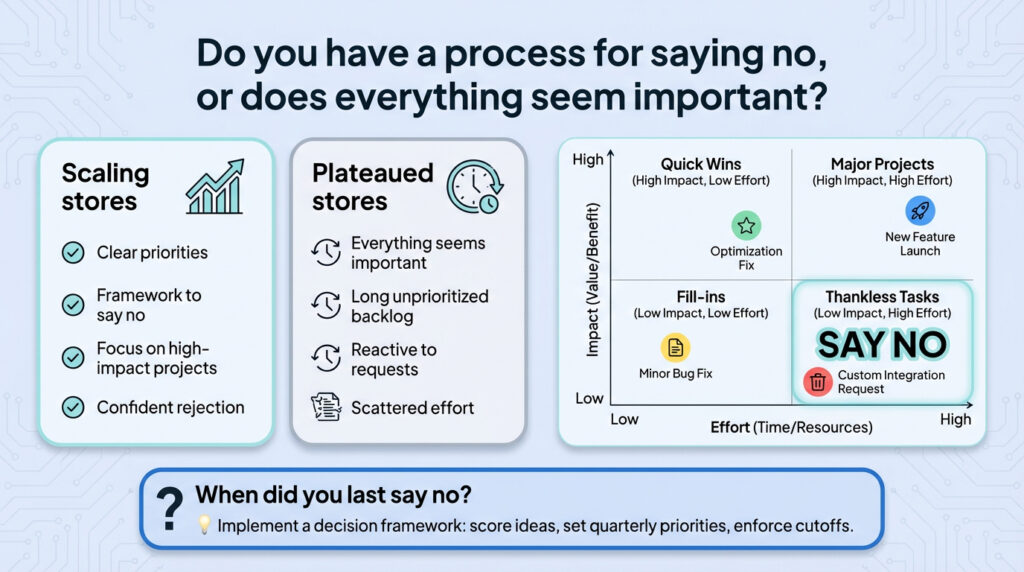
Stores that scale have clear frameworks for deciding what to work on and what to defer or reject. They know their priorities. They can confidently say no to things that don’t align with those priorities, even if those things seem valuable.
Stores that plateau treat everything as equally important. A customer asks for a feature—seems important. Marketing wants a new integration—seems important. Someone sees a competitor doing something—seems important. Everything gets added to the list, and the list just grows because there’s no real framework for deciding what actually matters.
The result is scattered effort across too many priorities, nothing getting done particularly well, and a business that’s reactive to every request instead of focused on what actually drives growth.
Ask yourself: when was the last time you said no to something that seemed like a good idea? If you can’t remember, you probably don’t have a real prioritization process. You’re just doing everything anyone suggests, which means you’re not focused on the things that actually matter for scaling.
Question 5: Can you onboard a new team member without them needing weeks of verbal knowledge transfer?
If a new developer, marketer, or operations person joins your team, can they get up to speed by reading documentation and exploring systems? Or do they need weeks of explanations from existing team members about how things work, why decisions were made, and where everything is?
Stores that scale have documented processes, clear system architecture, and knowledge that exists outside people’s heads. New team members can become productive relatively quickly because information is accessible.
Stores that plateau rely heavily on tribal knowledge. Everything important exists only in the minds of specific people. If those people leave or are unavailable, nobody else knows how things work. Scaling requires hiring, but every new hire needs extensive knowledge transfer from existing staff, which slows everyone down.
This is also a bus factor question: if your key technical person or operations person disappeared tomorrow, how long before the business grinds to a halt? If the answer is “immediately” or “within days,” you have a serious scaling constraint.
Document how things work. Make knowledge accessible. If you can’t, you can’t scale past the capacity of the few people who hold all the knowledge in their heads.
Question 6: Are you optimizing for launch speed or for long-term quality?
Every business makes tradeoffs between shipping fast and building well. Both matter. But which one drives your decisions more often?
When choosing how to build a feature, do you default to “what’s fastest to launch” or “what’s right to build”? When evaluating technical debt, do you see it as an acceptable tradeoff for speed, or as a problem that needs managing?
Stores in growth mode often need to move fast. That’s fine. But if fast is always the priority and quality is always sacrificed, you accumulate debt that eventually makes everything slow. You reach a point where you can’t move fast anymore because the codebase is too fragile and the systems too complex.
Stores that scale successfully balance speed and quality. They move fast when it matters, but they also dedicate time to building properly and paying down debt. They know when to take shortcuts and when shortcuts will cost more later than doing it right now.
If your default answer to “how should we build this” is always “whatever’s fastest,” you’re building scaling constraints. Eventually, fast and fragile becomes slow and broken, and you’ll need to stop and rebuild before you can grow further.
Question 7: Do you know which numbers actually predict revenue, or are you just tracking everything?
Most stores track dozens of metrics. Website traffic, conversion rate, average order value, email open rates, social engagement, ad impressions, bounce rate, pages per session, on and on.
But which of these actually predict whether revenue will grow? Which are leading indicators you can act on versus trailing indicators that just tell you what already happened?
Stores that scale have identified their three to five key metrics that actually drive the business. They focus on those. They understand the relationships between them. They make decisions based on moving those specific numbers.
Stores that plateau track everything but focus on nothing. They look at dashboards full of metrics without really knowing which ones matter. When things go wrong, they don’t know which metric to investigate first. When making decisions, they can’t point to the specific numbers they’re trying to improve.
If you can’t name your top three business metrics and explain why they’re the right ones to focus on, you’re probably tracking noise instead of signal. And businesses that can’t distinguish signal from noise don’t scale efficiently.
Question 8: When you evaluate partners or tools, do you consider exit costs?
Choosing a payment processor, a shipping integration, a marketing platform, an analytics tool—most stores evaluate these based on features and monthly cost. Does it do what we need? Is the price reasonable? Great, let’s use it.
But what about exit cost? If this tool or partner doesn’t work out, how hard is it to switch? Is your data portable? Are you locked into specific formats or APIs? Will changing require rebuilding major parts of your business?
Stores that scale think about exit costs upfront. They choose tools and partners where they maintain control and flexibility. They avoid deep lock-in to vendors where switching would be painful enough to prevent them from making better choices later.
Stores that plateau optimize only for immediate fit and cost. They end up locked into tools that were fine at €300k revenue but don’t work at €1M+, and switching would be so expensive and risky that they just live with the limitations.
Every choice you make either increases or decreases your future flexibility. If you’re consistently making choices that lock you in and reduce flexibility, you’re building constraints that will limit growth when better options become necessary.
Question 9: Do you regularly kill things that used to work but don’t anymore?
Every successful business accumulates barnacles: features, processes, integrations, partnerships, product lines that made sense once but don’t anymore. They’re not actively harmful. They just create drag—maintenance burden, complexity, distraction.
Stores that scale regularly audit what they’re doing and actively remove things that aren’t pulling their weight. They’re not sentimental about features that used to be important. If something isn’t serving the current business strategy, it gets cut.
Stores that plateau keep everything forever. That feature someone asked for three years ago and five people use? Still maintained. That partnership that generates €200/month in revenue but takes hours to manage? Still active. That product line that barely sells but requires inventory and attention? Still in the catalog.
The accumulation of legacy commitments creates increasing drag on the business. More to maintain, more complexity to manage, more decisions to consider. Eventually, the drag becomes heavy enough that it significantly slows execution
When was the last time you killed a feature, ended a partnership, or discontinued a product line that wasn’t actively failing but just wasn’t worth continuing? If you can’t remember, you’re probably carrying too much legacy weight.
What these questions actually reveal
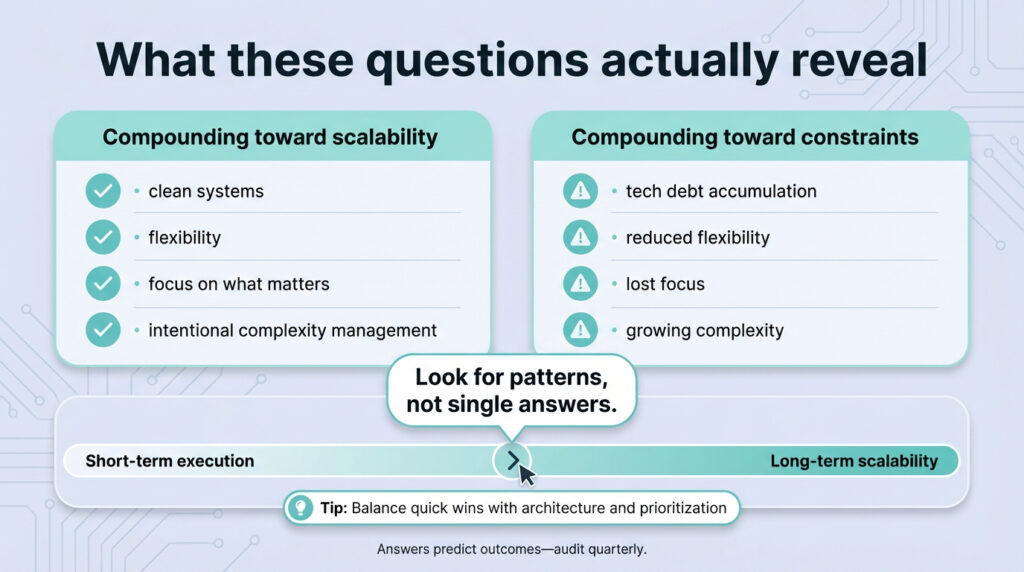
These aren’t random questions. They’re specifically designed to surface patterns in how you make decisions that predict scaling outcomes.
Stores that answer most of these questions well are making decisions that compound toward scalability. They’re building clean systems, maintaining flexibility, focusing on what matters, and managing complexity intentionally.
Stores that answer most of these poorly are making decisions that compound toward constraints. They’re accumulating debt, reducing flexibility, losing focus, and creating complexity that will eventually limit growth.
The individual answers matter less than the pattern. If you’re consistently optimizing for short-term execution without considering long-term implications, you’re building a business that will hit a ceiling. If you’re balancing short-term needs with long-term scalability, you’re building one that can grow sustainably.
The uncomfortable truth about scaling constraints
Here’s what makes this difficult: the decisions creating scaling constraints feel right when you make them. Ship fast, solve the immediate problem, keep costs low, stay flexible, don’t over-engineer. These are all reasonable heuristics for running a business.
The problem is that consistently applying these heuristics without considering their long-term implications creates accumulated technical and operational debt that eventually becomes insurmountable without significant investment to unwind.
By the time you realize you’ve hit a constraint, fixing it is expensive and disruptive. You can’t easily change platforms when your entire business is built on top of one. You can’t easily rebuild your fulfillment process when you’re processing orders daily. You can’t easily refactor your codebase when you don’t have documentation and the original developers are gone.
So stores either live with the constraints and accept slower growth, or they bite the bullet and do expensive, risky rebuilds to remove the constraints they wish they hadn’t created in the first place.
The smarter path is being intentional about these decisions upfront. Not over-engineering or gold-plating everything, but making conscious choices about where to invest in quality and flexibility versus where to move fast and accept tradeoffs.
If your answers reveal problems
If you went through these questions honestly and realized you’re making decisions that will create scaling constraints, that’s actually good. You’ve identified problems before they become crises.
Some of these you can fix yourself with changes to how you make decisions and what you prioritize. Better documentation doesn’t require outside help. Saying no more often is a discipline issue, not a technical one. Identifying key metrics is strategic thinking you can do internally.
Other issues—messy technical architecture, accumulated technical debt, fragile integrations—often require expertise to untangle. Especially if you’re already at the point where the constraints are limiting growth and you need to fix them without disrupting current operations.
That’s work we do at BrandCrock. Auditing how stores are set up, identifying where current decisions are creating future constraints, and helping unwind the accumulated debt that’s limiting scaling. Not just fixing immediate problems, but helping establish patterns and processes that support sustainable growth.
If you’re at a plateau and suspect accumulated constraints are the reason, or if you’re growing and want to avoid building constraints you’ll regret later, reach out. We’ll look at your specific situation and tell you honestly what we see—where decisions are creating problems, what it would take to fix them, and whether that work makes sense for where you’re trying to go.
Because scaling isn’t just about getting more customers or selling more products. It’s about building a business that can handle growth without breaking. And that comes down to making better decisions about the things that don’t seem important until suddenly they are.
The time to think about scaling constraints is before you hit them, not after. These nine questions help you identify which decisions are setting you up for sustainable growth versus which ones are building walls you’ll eventually crash into.
Answer them honestly. Fix what needs fixing. And build a business that can actually scale when you’re ready to grow it.


 Vaid Ali
 Sep 28, 2025