Shopware 5 to 6 Migration and Custom B2B Shop Development for a Dealer-Only Commerce Platform
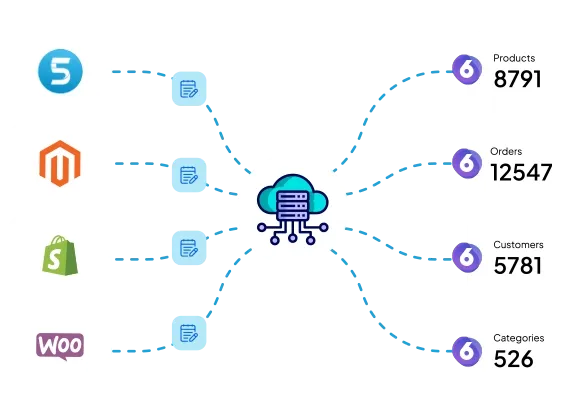
Avoria Liquid needed a dedicated Shopware 6 B2B shop separate from its existing mixed-data Shopware 5 setup. The project combined filtered B2B-only migration, custom theme implementation, dealer access control, faster ordering workflows, custom plugin development, go-live, and long-term support. BrandCrock delivered the project as a full B2B Shopware 6 build designed for practical dealer operations rather than a simplified copy of the legacy shop.
Project Snapshot
Client:
Avoria Liquid B2B
Platform:
Shopware 5 → Shopware 6
Industry:
B2B eCommerce for vaping products
Target Group:
Registered B2B customers
Business Model:
Dealer / wholesale commerce
Scope:
Installation, migration,custom theme & plugin development, post-live support & stabilization.
The Challenge
Avoria needed more than a standard Shopware migration. The objective was to build a dedicated B2B shop that would separate dealer business from a Shopware 5 environment where B2B and B2C entities were stored in the same system.
That created two core challenges.
First, the migration could not be handled as a direct system copy. Customers, orders, and products had to be filtered so that only the relevant B2B entities would move into the new Shopware 6 environment. Product media was stored on a CDN server and therefore also required controlled mapping and import.
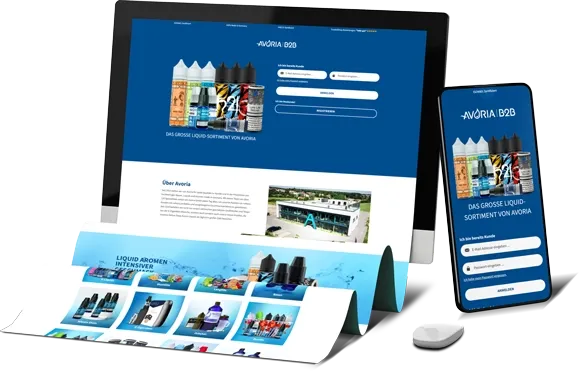
Second, the new B2B shop needed workflows that standard Shopware did not provide by default. Avoria wanted the platform to function as a true dealer shop, which meant unregistered visitors should not be able to browse categories, listings, or prices. At the same time, the login and registration area had to remain commercially usable and visually aligned with the wider Avoria brand.
Key challenges
- Filtering B2B-only customers, orders, and products from mixed Shopware 5 data
- Filtering B2B-only customers, orders, and products from mixed Shopware 5 data
- Creating a custom Shopware 6 B2B theme aligned with the existing B2C CI
- Restricting categories, listings, and prices for non-logged-in visitors
- Building a dealer-friendly login and registration entry point
- Developing a tabular list view for faster B2B ordering
- Enabling bulk add-to-cart without forcing users through repeated product-detail steps
- Carrying the project through go-live, support, and maintenance
What We Delivered
BrandCrock delivered the project as a full Shopware 6 B2B implementation rather than a migration task alone.
A staging environment was created first so development and testing could progress in a controlled setup. From there, the new Shopware 6 B2B shop was developed from installation and configuration through to go-live. The storefront was built on a custom theme designed around Avoria’s dealer requirements while staying visually aligned with the existing B2C business. BrandCrock also designed and implemented custom email templates and invoice templates to support consistency across the wider B2B customer journey.
The migration focused specifically on relevant B2B entities from the old Shopware 5 environment. Instead of moving all source data, BrandCrock filtered only the required B2B customers, orders, and products into the new B2B store. Product media from the CDN source was also mapped and imported into the Shopware 6 shop.
Where standard Shopware behavior was not enough, BrandCrock developed custom extensions for the dealer workflow. This included the B2B access-control and redirection logic, the tabular list view for faster ordering, and the bulk add-to-cart process for multi-product purchases. The result was a Shopware 6 B2B platform designed around dealer behavior rather than a generic storefront with hidden prices.
Implementation Highlights
01
Filtered B2B migration from a mixed Shopware 5 environment
The old Shopware 5 shop contained both B2B and B2C data. BrandCrock filtered the relevant B2B customers, orders, and products and migrated only those entities into the new Shopware 6 B2B shop. CDN-based media was also mapped and imported into the new store.
Outcome: the new platform started with a clean B2B-relevant data structure instead of inheriting a mixed legacy environment.
02
Custom B2B theme aligned with the wider brand
The new B2B shop had to meet dealer requirements without breaking visual continuity with the existing B2C business. BrandCrock implemented a custom Shopware 6 theme to support both.
Outcome: the B2B shop became visually consistent with the wider brand while remaining tailored to a dealer-focused audience.
03
Login-restricted B2B access control
Avoria wanted visitors to register or log in before viewing categories, listings, and prices. BrandCrock developed a custom B2B redirection plugin to enforce this logic and shaped the entry experience so it remained usable for dealer onboarding.
Outcome: the shop matched B2B access expectations while keeping the entry flow commercially workable.
04
Tabular list view for faster dealer ordering
The client required a tabular list view to support quicker B2B ordering, but this was not available in standard Shopware. BrandCrock developed a custom extension with a dedicated controller to map dynamic values into a tabular listing format.
Outcome: dealers gained a faster and more practical way to review products and place quick orders.
05
Bulk add-to-cart workflow
To reduce friction in multi-product ordering, BrandCrock developed a bulk add-to-cart extension. Buyers could enter quantities directly in line items and add multiple products to the cart in a single action without visiting individual product pages.
Outcome: ordering became more efficient for B2B users purchasing multiple products at once.
06
Full delivery through go-live and beyond
The project also included staging, email and invoice template work, go-live execution, and ongoing support and maintenance after launch.
Outcome: Avoria received not only a complete Shopware 6 B2B shop, but also operational continuity after go-live.
Outcome
The Avoria Liquid B2B project delivered a dedicated Shopware 6 dealer platform built around practical B2B workflows.
The new setup separated B2B operations from the mixed legacy environment, restricted product and price visibility to registered business users, improved ordering speed through tabular listing and bulk add-to-cart, and kept the visual identity aligned with the wider Avoria brand.
- 1,295 hours of documented project effort
- Dedicated Shopware 6 B2B shop for dealer business
- Clean migration of relevant B2B customers, orders, products, and media
- Controlled product and price visibility for registered users only
- Faster ordering through custom tabular list view and bulk add-to-cart
- Brand-consistent B2B storefront instead of a generic dealer portal
- Full implementation path from staging and development to go-live and support
- Stronger technical basis for long-term maintenance and further development
Planning a Shopware 6 migration for a B2B shop?
If your project combines migration, dealer access control, and custom ordering workflows, a structured technical review can reduce avoidable risk before it affects launch and daily operations.